Friday, October 26, 2018

"The Hunter" review


"A stranger in a strange land" has been a stable of storytelling throughout human history. While arriving alone to a location, a character can try as he can to remain who he was before his journey, but he will almost certainly be changed by those around him.  The journey itself can change the character, and have them grow into someone different and new.   Daniel Nettheim's 2011 film The Hunter is one such film which follows this trope.
                The story is that of Martin(Willem Dafoe) a mercenary hired by a company to track down, and kill the last Tasmanian tiger in existence, due to the creature's pharmaceutical capabilities.  During his mission Martin is given lodging with a local woman(Frances O'Connor) and her children, who have been rocked by the disappearance of her husband one year prior.  While the children are more than excited to have some company, the wife has since fallen into a neigh cationic state via stupor brought about by over-prescribed medication.  Along with having to hunt the tiger, and restoring the family's homestead, Martin must deal with Jack(Sam Neil), local guide who seems to have an ominous connection with the family, as well as local loggers who want outsiders to stop imposing on their livelihoods.  All of this transpires around Martin, while he still ventures out into the wilderness in search of the legendary creature.
                Dafoe is in his element as the slightly-distant mercenary, who at first is only concerned about his mission, but becomes a sort of replacement for the family's missing husband.  He comes across as a man who gains a sense of humanity which was missing, but regains it throughout his journey.  Concise, cold, and a man who tries to focus on his job, but gets sidetracked by the world around him.  As always Sam Neil is fantastic in any of his roles, though mostly known for his work in Jurassic Park he has a large filmography full of quality work.  There are two child actors in the film who are actually very good, where as in some films a scene can be killed by a child actor who is placed in the film because one of his family is a producer on the film, or something.  But the performances by young actors Morgana Daviesand Finn Woodlock are quite good, and fit well with the tone of the story.
                When it comes to the visuals, the film relies heavily on the wild, and at times almost alien landscape of Tasmania.  Where as in film Australia is generally restricted to the red sands of the outback, or the rainforest areas along the country's east-coast, The Hunter reveals Tasmania to viewers who might have the foreign land revealed to them for the first time.  The variation in the landscape changes throughout the film, and works as a way to frame Martin's journey.  The house he stays at is in a very grounded and peaceful forest area, but as he gets closer to finding the tiger nature becomes more hostile, starting with a temperate forest, to marshland, and eventually to a snow-covered mountain area.
                The setup of the film is Martin's search for a creature which is supposedly extinct, but during most of the movie that plotline takes a backseat to his interaction with the locals, and the effect that he as an outsider has on the community.  Where are before his arrival things weren't great, the townsfolk and loggers were content to live their lives, but the rumors of a living Tasmanian tiger have begun to spread, and fears that conversationalists will put an end to the logging rise up.  This of course leads to mob mentality which causes trouble for Martin, as well as anyone who isn't in favor of the logging industry. Though Martin has no real stake in the outcome of anything besides his job be has built up enough of a connection with his hosts that he does try and affect the situation, albeit not in a direct manor.
                The Hunter is a superb film, visually, writing-wise, as well as fantastically acted with an amazing performance by Willem Dafoe being the highlight of the film.  Martin's journey as a character is the cornerstone of the film, with the audience following him throughout his trials and tribulations in search of an animal thought to be long dead.

"Filth" film review


            Not all protagonists in films are goody-two-shoe, Boy Scout types.  Character flaws can make a film's hero more sympathetic, or give them more of a challenge in overcoming their obstacles.  But can we like a main character when he is made out to be one of the worst possible examples of a human being without making them completely monstrous?  In the example of the film Filth directed by Jon S. Baird,  the answer is a surprising yes.
                Bruce Robertson(James McAvoy) is a slimy, low-down detective Sergeant in Edinburgh, Scotland who tries to manipulate his way to a promotion via a murder investigation, believing this to be the key to winning back his family.  Along with investigating the murder itself, Bruce goes through the list of all his compatriots and devises a way to either remove them from the running for the promotion, or display their ineptitude. In his personal life Bruce enjoy bullying his mild-mannered, well off friend Bladesey(Eddie Marsan), as well having visits/hallucinations with his deranged Australian doctor(Jim Broadbent).  While the main plot point of the story is the murder of a Japanese foreign exchange student, the investigation is more of a backdrop to an exploration of Bruce's character.
                As previously stated, Bruce is scum, one of the lowest forms of human life, filth incarnate, yet he is somehow enduring, and against all odds, likeable.  Starting with the first appearance of the character he is constantly doing something vulgar, sexually devious, or downright deplorable.  Normally this kind of behavior would make a character despised by the audience, Bruce has an undeniable air of charisma about him, as well as certain charm.  This is due in part to both the excellent writing, and an incredibly strong performance by McAvoy who is able to portray this human pile of garbage without making it overly hokey.
                Thankfully the horrid behavior of Detective Sergeant Robertson is merely the outward shell of his true character: an incredibly broken man.  Throughout the film the true nature of Bruce's past and mental issues come to reveal themselves fully.  Every once and a while hallucinations will emerge, changing people's faces into those of various animals, namely Bruce looking like a pig.  The hallucinations are brought on by the combination of alcohol and medication that Bruce is constantly consuming, essentially trying to bury the pain brought about by the loss of his family.  As the story continues the audience is show the great extent of the mental illness, and how it extends towards the rest of Bruce's life as well as how it effects everything around him.  Despite his deplorable behavior, there is still the remnant of a good man still left within him;  one of the few positive actions he takes in the story is when on the street berating a homeless man, Bruce is the only one to take action to save the dying man.  This one scene strengthens the audience's attachment to their loveable boor, but is also an allegory for the his situation: he is the only one who can take action to save himself.
                The film is able to present itself visually in a way that presents the bleakness of the story, washing out most scenes with a faint blue tinge.  Story wise the events take place around Christmas, but the somber presentation of the streets of Edinburgh take precedence over the normal cheery nature of the holiday.  With images of Christmas strewn few and far between, with one scene having a homeless man wearing a Santa hat showing the sometimes superficial nature of the holiday; try as you may, but sometimes you can't cover up problems with the facade of something cheerful and happy.  That very idea works well as a way of looking at Bruce, while he is a vulgar and lewd ass, he also has a plethora of underlying issues which simply cannot be covered up.
                Along with James McAvoy, the cast gives a great performance, as mentioned before Jim Broadbent as Dr. Rossi, a hallucination that tortures Bruce in the guise of a demented psychiatrist.  Jamie Bell(Billy Elliot) as the rookie detective Lennox who has taken by Bruce's both as a protégé and as a detective and as a stepping stone for promotion.  Chrissie, played by Kate Dickie(Game of Thrones), is both the wife of one of Bruce's fellow detectives, as well as one of his many mistresses he uses to try and fill the void in his life.  Perhaps one of the more important characters is Eddie Marsan's Bladesey, who is Bruce's only friend, despite his constant bullying and mistreatment of him.  Though Bladesey can be seen as a punching bag, he is the only character who seems to care about Bruce, though it can be seen as misguided, rather than the last human connection left in his life.
                Filth is quite an amazing film, while there have doubtlessly been films before made about corrput cops, they weren't made quite like this.  Given the subject matter this film could have been quite unremarkable, but it gives it own spin on various themes and ideas, and takes strides in its macabre tones, and does not pull any punches.  If you are looking for a dark, raunchy, funny, and also incredibly worthwhile film, Filth should be at the top of your list.

Tuesday, May 2, 2017

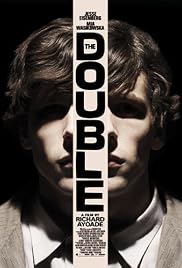
The Double


The concept of the doppelganger is a very strange, and at times unnerving thing. Out there, there is someone who is your exact double in many ways, living a life completely separate from that of your own. What were to happen if you were given the chance to meet that double of yours? Richard Ayoade’s 2013 film The Double explores just such a situation.
Based off of a novella by Fyodor Dostoyevsky, The Double is the story of Simon James (Jesse Eisenberg), a government clerk who seems to become more and more invible to people around him each day. Everyday on his way to work, he tries to enter his office via his work ID, but is never recognized by the security guard who is at the desk every morning, as well failing to grab the attention of his boss played by Wallace Shawn (The Princess Bride). One morning a new employee arrives to the office following an almost celebrated intro, once Simon sees the new employee he ends up astonished, because the new guy is an exact duplicate of himself. The new employee, who’s named James Simon may appear identical to Simon his personality is the complete opposite, being brash, charming, and confident compared to his double, who is meek, quiet, and non-standoffish. After a time the two start to work together to further each others’ station, James wishes to move up the coporate ladder at work, while Simon pines for the affection of one of the girls from the copy room, Hannah played by Mia Wasikowska (Alice in Wonderland). At first things go well, until James begins to manipulate Simon, furthering his own needs with blackmail, sending the clerk’s life into a tailspin.
The director of the film is Richard Ayoade, who is best known for playing the character of Moss on the television show The IT Crowd. He began his directing career with his 2010 film Submarine. The story of a fifteen-year old boy on his quest both lose his virginity, and to destroy the relationship between his mother and her ex. Submarine is a great film, in a style akin to something created by director Wes Anderson, though without the fixed color palette that his films feature. As a director Ayoade is quite confident with his material, with the best aspect of his work being his focus on directing his actors. All of the characters in his films are very believable, and the protagonists are generally more relateable than likable, which can be a hard thing to have carry your film. Yet, Ayoade has been able to accomplish this in both of his films so far, perhaps he will be able to continue it throughout the rest of his career.
With his previous film Submarine, much of Ayoade influence was clearly from the films of Wes Anderson, namely one such as Rushmore. However, The Double being a much different story has very different atmosphere, choosing to take a more industrial and isolated look to the film rather than that of one in what is seemingly the read world. Simon’s world is one of browns, and grays, full of bland concrete buildings, and a general lack of individuality, everyone and everything being yet another cog in society’s machine. This time around, Ayoade’s influence appears to come from Terry Gilliam’s film Brazil. With a similar story of a government clerk stuck in a psudo-dysopic world, the comparisons between the two films are numerous, the bland industrial surroundings, the citizens blind to their own bleak-lives.
As previously mentioned, the director likes to concentrate on lettings his actors know how to react to their surroundings as well as each other. Jesse Eisenberg puts in a solid effort as both Simon and James, being able to convey subtle differences between two sides of a same coin. While the two characters do have different personalities, one being small and mousy, the other being direct and on-point. Performance wise Eisnenberg doesn’t vary too far between the two characters, perhaps as a way to show how James is able to manipulate everyone around him. The supporting actors also put in good performances, Wallace Shawn does well as the loud and oblivious Mr. Popadopoulos, putting good use to his high-piercing voice. Mia Wasikowska puts in a very reserved job as the love interest of the film, portraying the character of Hanna as a strange, delicate, yet also somewhat independent.
The Double is quite an interesting film. The story of dealing with two polar opposite personalities which seem to emanate from the exact same person makes for a curious spectacle. In addition the characters, and the mildly-bleak world in which the story is held makes for an interesting arena for the plot. If one has the chance, and an interest in a less than straightforward movie, The Double is worth a viewing.

Burke & Hare


Genres are flexible, most films which are labeled with the title of “science fiction” are almost always group together with another classification, such as horror, drama, and thriller. The same goes for comedy, which can be broken down into further sub-genres such as parody, slapstick, or in the case of 2010's Burke and Hare, black comedy. Black comedies take a somber, or macabre setting and turns them on their head, with plots which sound as though they should be dramas or horror film, and instead makes light of a darker situation. Stanley Kubrick Dr. Strangelove is a prime example of this type of film, poking fun and making light of the ever-looming threat of nuclear war during the 1960's.

Directed by veteran comedy and horror director John Landis, Burke and Hare tells the semi-true story of two Irish con men in 19th century Edinburgh. At the start of the film we are introduced by a narrator/hang-man (Bill Bailey) who tells the audience of the fact that in the 19thcentury Edinburgh was the center of medical research in the world, and how one professor Monro (Tim Curry) forges an official letter which allows him to hold the monopoly on fresh hanging victims for medical research.

This prevents Dr. Knox (Tom Wilkinson) from having any subjects for his medical classes, until two down on their luck Irishmen Burke (Simon Pegg) and Hare (Andy Serkis) must dispose of the body of an elderly boarding house tenant, and find they can make a profit from murdering victims and selling the corpses to Dr. Knox. This leads to an investigation by Scottish militia and a series of hijinks from a cast of characters throughout Edinburgh.
This film benefits from great writing, which gives each character a unique voice allowing everyone to be funny in individual ways. Though the plot is based off of true events, as stated in the opening of the film not everything is historically accurate. Being upfront about this fact is both cheeky, but it also queues in the audience to not take the film seriously, which loosens up the atmosphere, allowing for it to appear historical, but not take itself seriously in the slightest. Full of witty quips, clever twists, silly caricatures, and had-hitting slapstick, Burke and Hare doesn't slow the flow of comedy from constantly filling screen time, and it does so without becoming tried.

Visually the film looks like a period-film, perhaps one discussing the politics of 19th century Britain, or a film about a young medical student fighting against all odds to make some kind of miracle breakthrough in the field. While at first glance it looks like something which is perhaps meant to be serious, simply watching for a few moments will reveal its true nature. This juxtaposition makes for a very humorous look at what is historically seen as the serious story of two serial killers in Scotland.

All of the actors bring their A-game, every one with their own brand of comedic delivery and timing. With such a wide variety of comedy on display one can find at least one performance to tickle them in just the right way, leaving them with a memorable line, or visual gag stuck in their thoughts for the rest of the week.

There aren't very many problems with the film per-se, except perhaps the casting of the two main characters of William Burke, and William Hare. Simon Pegg and Andy Serkis do exceptional jobs as the two Irish con artist, but there therein lies the issue, why couldn't they cast two actual Irishmen to play these historical figures? There isn't a shortage of comedic Irish actors in the film industry, one could easily see the likes of Chris O'Dowd (The IT Crowd), Sean Hughes (The Last Detective), Dylan Morgan (Shawn of the Dead), or Gabriel Byrne (The Usual Suspects) in the titular roles. Now, this isn't really a critique of Pegg and Serkis who both do an excellent job, but it does lead one to wonder if actual Irish actors might have brought something different to the roles.

In all, Burke and Hare is a great work of comedy which might have been overlooked for the last few years, but it worth giving a watch. 

Wednesday, January 15, 2014

The Secret Life of Walter Mitty


What happens when we let our imaginations get the better of us?  Everyone has had run-ins with a daydream that we let take over our entire thought process, whisking us away on adventures that normally we'd never embark on.  This is the theme of Ben Stiller's film The Secret Life of Walter Mitty. 
                Stiller directs and stars in a film about Walter Mitty (Stiller), a photograph negatives manager at LIFE magazine, which is going through a transition from print to being solely online only.  In the last week of the magazine he is given the task of providing a photo which would be the cover of the final issue.  While reviewing the negatives from the roll of film, it is found that the photo to be used on the cover is in fact missing from the negatives.  Mitty takes it upon himself to track down the mystical photographer Sean O'Connell(Sean Penn) in an attempt to recover the missing photo to properly send of the magazine.  His search ends up taking him across the word to find O'Connell,
                The film goes back and forth between Mitty's real life, and the life of his fantasies which blend into his current situation, letting his imagination play out.  Normally the fantasies begin with something that is currently happening, then taking off into a completely unreal situation.  While at work Mitty has run ins with the new boss (Adam Scott), who is in the middle of brutishly downsizing the magazine, and singling out Mitty in much of his teasing.  In one scene Mitty and the new boss are in an elevator together, eventually they start getting into a fight which quickly transforms into a James Bond-esque brawl, then leads to an action scene pulled out of a superhero movie.  But as soon as the fantasy is over we are snapped back into reality, to see that Walter has simply spaced out in thought, letting time pass around him unseen.
                Visually this movie is stunning, every shot is like a photograph, which of course makes sense with the subject of the film being a quest for one photograph.  There is not a shot in the movie which seems out of place visually, they all fall into the same style.  During Walter's "regular" life, things are shot very flat and at precise angles, never straying too far from looking slightly mechanical.  But once he goes on his journey the camera opens up and starts breaking out of its previously level and flat shots.  This opening up works well with the film's progress, as Mitty goes on to break out of his dull existence working in the basement of a magazine, and into a journey across the globe.
                Generally the characters all feel real, Ben Stiller works well as the slightly-drab everyday man in a dying field, who's imagination allows him some escape from an otherwise unfulfilling life.  Along with Stiller is Kristen Wiig as Cheryl, a woman whom Mitty works with, whom is also his love interest.  Patton Oswalt who is an over-the-phone tech support with eHarmony who seems to be able to call Walter anywhere in the world, perhaps even in places where cell phone coverage wouldn't reach.  Sean Penn plays the mysterious and semi-mystical photographer whom Walter searches the world for; a man who doesn't seem to exist in the same universe as everyone else.
                The film does have a few flaws, namely when it comes to the fantasy sequences.  In the first half of the movie they feel too numerous, which makes sense story-wise but they slow the story down too much.  They are meant to give the viewer an idea of what is going through Walter's head, and his longing for something more out of life, but at times they just bring the movie to a halt.  There is one in particular that feels completely detached from the tone of the film, it being a direct parody of another film.  The film suffers for its inclusion.
                Overall, The Secret Life of Walter Mitty is a very nice film, it has a sympathetic protagonist whom you grow attached to throughout his journey.  The film has a very nice visual style which is pleasing to the eye, as well as some nice emotional moments.  If you want to see a competent, feel-good, and visually pretty film, I'd say check it out.

Thursday, June 7, 2012

Ivan's Childhood


 Film: Ivan's Childhood
Genre: War/Drama
Director: Andrei Tarkovsky
Year: 1962
Starring: Nikolay Burlyaev, Valentin Zubkov, & Yevgeni Zharikov


Out of all the things that shaped the world in the Twentieth century, the effects of World War II seems to have been the biggest, and most lasting. The aftermath left the world with two superpowers, placed the boundaries of most of the world's countries, and kick started a boom in technological development. So, it shouldn't be so much of a wonder as to why films about stories from the war intrigue us, and why they've remained a popular genre since the end of the war.

 For reasons not entirely clear to myself, I've seemed to have had a particular interest in Russian things, whether it be the language, culture, people, and so on. But Russian cinema seems to be a bit hard to come by, even when I attended film school they rarely showed up. I even enrolled in a Russian language through film class, and we only saw a handful of films. So, I'm always out looking for more cinema from geographically, largest country on Earth.

Ivan's Childhood is the story of an orphan boy who becomes a spy on the Russian front during Hitler's invasion eastward into the Soviet Union. While there is no real antagonist we see Ivan, or his fellow soldier's face, we are privy to a slice of their lives, and just the general malaise of war not on the front lines. Also, we see the effects the situation has had on Ivan, and his dreams taking him back to the times before the war took his mother. The Soviet soldiers present seem to be cut off from the rest of the world, staying in an isolated bunker, or in a lonely forest. Perhaps as a way of expressing the emptiness of the vast country following World War II, and the actions taken by Stalin following it.

 As there is no real linear plot, the film decides to take on a more character based approach to storytelling. Because of this, the film tends to drag a bit at times, even having long segments where Ivan is absent, and we follow his fellow Soviets, learning about Ivan through their experiences with him. The title of the film is something of a political statement, as Ivan's childhood seems to be a thing of the past, only being present in his dreams. This isn't really a film for the casual viewer, most of it contains complex symbolism, and the fact that it was made with a Soviet mindset distances it from modern audiences even more. Though, that was likely the point, expressing the underlying emotions going through the minds of the Soviet people, perhaps unable to express themselves in a more direct area.

Memorable Moments:
 • The film includes several dream sequences; in one the camera makes a jarring zoom onto a character's face, reminiscent of the camera moves used by Sam Raimi in Evil Dead 2.
• There is a scene after Ivan escapes from military custody and finds an old man living in his bombed out house, waiting for his dead wife to return. Shows the effects the German invasion has taken on normal citizens quite well.

Sunday, January 22, 2012

Submarine


Film: Submarine
Genre: Comedy/Drama
Director: Richard Ayoade
Year: 2010
Starring: Craig Roberts, Yasmin Paige, & Noah Taylor


For most of us being a teenager is awkward and confusing. Movies have been expressing this kind of feeling for a long time, making itself really known in the 80's, via the work of John Hughes, but these kinds of film have existed before the era of bright colors and bad haircuts. On top of that, this film is about the adolescence of a young British (Welsh to be more specific) man, dealing with his life in his own way.

The film is based on a novel of the same name by Joe Dunthorne, and is the coming-of-age story of a young Welshman named Oliver Tate(Roberts). Like most teens, Oliver isn't the most popular kid in school, but he also isn't the most outcast or spat upon, he seems to remain more in the middle. He has a crush on a girl in his class named Jordana(Paige), and uses his imagination and general teen urges to get him to fall for him, even though it requires him to throw the class outcast into a pond. Along with his romantic desires, he deals with the apparently failing marriage between his parents, which only gets worse when his mother's old flame moves in next door.

As with many teenagers, Oliver is far more clever and charismatic in his head than he is in reality. His narration of events is well constructed and preformed with great poise and grace, while his actual speech is often quiet and slightly-bumbling. There is a scene where he gives his girlfriend a stack of books which he wants her to read, thinking the books will make him appear more cultured and sophisticated than in reality. Even his physical movements are of that young and awkward age, he stands stiffly, rarely looking relax about anything.

Overall, the film is very good. It has the same feel as one of Wes Anderson's films, though it's much less colorful, perhaps as a way of responding to the Welsh environment that Oliver lives in, and has to deal with. Though in general the film lacks color, there are a few colors which are brought out, primarily blue(Oliver's room is blue, compared to his parents and the rest of the house, which are all beige), and the red of Jordana's jacket which makes her stand out whenever she appears on screen. Also, the film itself can be very funny, despite its subject matter, much like Anderson's films, with cleverly written lines sprinkled throughout, keeping with its more dramatic tone.

Memorable Moments:
• In the prologue Oliver mentions the fact that he sometimes daydreams about what would happen if he died. The following fantasy of thousands of people mourning his death, despite him not being well known, or even liked that much.


Friday, January 13, 2012

Tinker Tailor Soldier Spy


Film: Tinker Tailor Soldier Spy
Genre: Drama
Director: Thomas Alfredson
Year: 2011
Starring: Gary Oldman, Tom Hardy, & Colin Firth


Plenty of films have been made about the Cold War, and about espionage, from when they actually took place, and up until the modern day. Though for the most part people seem to think of spy movies to be more along the lines of series such as James Bond, which who is more a secret agent than a spy. Especially with all of those things blowing up and high tech gadgetry. So, the actuality of what spies really do is often overlooked, in favor for the more glamorous explosions. Which frankly, American audiences seem to enjoy more than talking.

The film is based upon a 1974 novel of the same name written by John le Carré, and subsequently a television series based upon the novel released in 1979, starring Alec Guinness as George Smiley, a British intelligence agent who was forcefully retired then brought back to help uncover a mole in the agency. The man brought in to carry out the investigation is as previously said: George Smiley. Who had been forcibly retried a year before, following a botched mission concerning an agent who was trying to obtain some sensitive information in Budapest. Though he does not have a lot to work with, he knows that the mole in the British intelligence agency AKA "The Circus" is all the way at the very top. Because of this Smiley is the best man for the job, as he was once at the top and he is able to look upon his history with those men responsible for the leak, and his original banishment.

Story wise, the film doesn't follow the normal narrative format, which is an interesting change when it comes to recent films. Instead of simply having everything play out in the order in which it happened, or in the order which best suits the audience, development is revealed in the same order that Smiley learns about it all. So, much like real espionage, or even life for that matter, you learn things in an order that you will have to rearrange yourself, as to see the bigger picture. Several people I have talked to complained that the move was confusing, but most of those people were my age or younger, and likely expected everything to be laid out in the order in which would make the most sense. But, life doesn't always happen that way, and nor should stories.

Overall I rather enjoyed the feel, and look of the film. Though I wasn't alive in the seventies, this film made me feel as though I was actually there, with fantastic set design, and cinematography. Every shot in the film feels like an old photograph you find in a box hidden away for years. It's warn, and colors have faded, much like the memories you might have about what is in the photo, so that's an interesting sensation coming from a film.

Along with the superb cinematography comes a fantastic cast: Gary Oldman, Colin Firth, Toby Jones, Mark Strong, and Tom Hardy; some of England's most highly renowned actors, all of whom make you believe in their roles. Also, the inclusion of actual Russian actor Konstantin Khabenskiy took me my surprise. He plays a Russian diplomat suspected to be involved in the leak, though it is not a large role, and has few lines (even fewer in English), the fact that they got an actual Russian actor is another surprise for me. Even more so, the fact that they could have just as easily have gotten an English actor to do the job, they got one of Russia's most famous actors to play the bit minor role. Well done.


Memorable Moments:

• Smiley's introduction. He is present and introduced early in the film, but remains silent for the first several minutes of the film. Allowing for the audience to get a feel for him emotionally, rather than though exposition.

• The inclusion of the French version of the song "Beyond the Sea" which plays at the end of the film. I was unable to recognize the song while watching, but it finally came to me once I left the theater and was in the parking lot.


Monday, July 25, 2011

Captain America: The First Avenger


Film: Captain America: The First Avenger
Genre: Action/War/Adventure
Director: Joe Johnson
Year: 2011
Starring: Chris Evans, Hugo Weaving, Tommy Lee Jones, & Hayley Atwell


Summer is a time for blockbusters, a time for action and adventure, and the lifting of one's spirit, making them feel alive again after a cold winter. Captain America: The First Avenger is one such blockbuster, and by golly it's a good one. The third of this year's Marvel movies, of which none have been a miss, or sub-par like Electra. The film's made by Marvel studios have all been very well made, films such as the Iron Man series, Thor, The Incredible Hulk, and now Captain America. Perhaps the studio knows that to make good products they need to put in as much passion into their films as they do their comics, as well they should.

Captain America has been around since 1944, making his debut as a comic book, and eventually moved to many other mediums, including film serials, cartoons, toys, and so on. Steve Rogers(Evans) is a skinny liberal arts student from Brooklyn, who has tried to enlist in the American armed forces several times, only to be rejected due to health reasons. But hope comes in the form of a defected German scientist who is working with the US government to develop a new "super-soldier" to help fight in the war in Europe. Rogers is given the treatment, allowing him to become the only super-soldier following an incident after the procedure. Eventually he goes to Europe to battle Hydra, a deep science division of the Nazis, that had made itself independent following the leadership of Johann Schmitt(Weaving). Schmitt also took the serum that made Rogers stronger, only before it was perfected, causing some side effects.

The majority of the film takes place in 1942, and boy does it pull it off with precision. The sets look like everything you would imagine things in World War II would appear like. I believe the only other semi-recent film that made me believe it was actually in the forties, was Saving Private Ryan, so there is a benchmark. Even the sets in the film that are of Schmitt's technological advancements still look like they are made with the state of art materials at the time. Technically the effects of the film look very good, especially Schmitt's Red Skull make up, he appears just as you would expect him to following years of comics.

The only problem I had with the film was some of the CGI, which at times is a bit noticeable. Before receiving the serum he is small and skinny, which Chris Evans is not. So, they used a body double, and inserting Evan's head in afterwards, though for most of the time it looks good, but at times it doesn't. In a few shots Evan's eyes are enlarged making him appear more like a bush-baby than a person, but the rest of the film makes up for any of these short comings.


Memorable Moments:

• Stan Lee's brief cameo, as an elderly military officer.

• The first meeting of Cap and Red Skull. The location, and tension are fantastical, it should go down as one of the best complete reveal of a villain in cinema history.

Sunday, July 24, 2011

Fast Times at Ridgemont High


Film: Fast Times at Ridgemont High
Genre: Comedy/Teen Drama
Director: Amy Heckerling
Year: 1982
Starring: Sean Penn, Jennifer Jason Lee, & Judge Reinhold


Every generation has its own slew of high-school centric films and television shows. With todays being such trip as Beverly Hills: 90210, whatever Selena Gomez is on, and so forth. Today's media puts its focus on the more popular, and good looking of the teenagers, most likely in a marketing scheme. WELL BACK IN MY DAY, shows were normally about the regular kids, who weren't the center of attention, but were like many of the viewers: just regular kids.

Comedy classic Fast Times at Ridgemont High is one of the said tales of a generation of American teenagers, specifically for those who came of age in the late seventies, and early eighties. Many people hold this to be the quintessential high-school film, and sets the bar for any films that followed in that genre. It is my believe that it deserves such a distinction, and it still holds up today, perhaps even better than high school movies made more in recent years. The film has a grittier feel to it that today's polished, and happy-go lucky attitudes like in the High School Musical franchise, and films like Disney's Prom.

The film revolves around several different students who go to the titular Ridgemont high, and their lives though out the autumn semester. Instead focusing on one particular character, it jumps around between a group of students, following their actions across the season. Though there is no particular main character, there is a list of some whom the story rotates around more often. Brad Hamilton(Reinhold), and his sister Stacy(Lee), with the iconic surfer-stoner Spioli(Penn) appearing every now and again to lighten up the tone.

I enjoyed this film, for its subtle humor, and apparently gritty realism. Unlike films today were everything is polished and cleaned up as to not poison the mushy minds of today's youth, this film doesn't hold back. It shows teens as what they really are: people. Often media's portrayal of teens is that of a pimply faced socially awkward introvert, or as a super good looking idol who's standards are so high the general public can meet. Teenagers make mistakes, try and do the right thing, and even at times act like, dare I say it: humans. Brad and Stacy are especially synthetic characters, you can easily see yourself in their position, and deal with their personal issues, and there is just something more compelling about that, rather than having them singing and dancing about going to lunch.


Memorable Moments:

• Any of a young Nick Cage (credited as Nicolas Coppala) brief appearances.

• Whenever people mention this film the always mention Sean Penn as Spicoli, though I was surprised to find he was far from the main emphasis of the plot. But I guess he looks good on the posters.

• After years of watching Clerks: The Animated Series I understand this joke:


Tuesday, June 14, 2011

Super 8


Film: Super 8
Genre: Sci-Fi/Adventure
Director: J.J. Abrams
Year: 2011
Starring: Joel Courtney, Elle Fanning, & Kyle Chandler


Alright, before I get to discussing the film itself, I want to gets some facts out there first. I enjoy the work of J.J. Abrams; I in no way go gaga over his name appearing on a project. Star Trek(2009) was great, LOST was good, but I would hardly call it one of the greatest television shows of all time. Are you still reading at this point? I have nothing against the guy (except maybe for the fact that he is credited for writing the screenplay for Armageddon,) but he just isn't something I would needlessly crap my pants about. Anyhow, I rather liked this movie, and it continues my like for Mr. Abrams, but it doesn't not make me want to kill someone just for a glimpse at his next project.

In the summer of 1979, a boy named Joe (Courtney) and his friends are making a movie for his friend Charles to enter into the Ohio super 8 film festival. Their film is a cheesy zombie film, but in the process of making it, great events happen. During the middle of the night, the boys and a girl named Allison (Fanning) film at a train station, while performing a scene a military train is derailed by a pick-up truck. Following a fantastic crash, something mysterious is released from the crashed train, and threatens the town of Lillian where the kids all live. After the crash many strange phenomenon happen, like power surges, and all of the dogs running out of the county. The sheriff goes missing, which leaves Joe's father: Deputy Lamb (Chandler) in charge of finding out what happened at the train crash, and what suspicious actions the military is taking.

Let me say that I love films like this, an adventure following a group of kids who have an adventure. These were popular in the eighties, and early nineties, but seem to have lost their place in the last decade. This film follows in the footsteps of films such as Stand By Me, The Goonies, The Sandlot, Stephen King's It, and even more recent films such as Monster House. These film resonate with me, for as I watch them, it makes me wish that my childhood was adventurous as these kids'. But, the innovation of video games, and the ever ominous presence of the fear of being murdered kept my generation inside for the most part.

The acting in his film is superb, without a single blemish on the face of Super 8's face. All of the young actors bring a great sense of wonderment, and essentially the mindset of yearly teens to the screen. With some movies the dialogue written for younger actors isn't particularly like how people of that age speak. But, this movie does justice to how boys in their pubescent years actually speak, so it's a nice change to see them not speak like businessmen. Along with the great young actors, Kyle Chandler gives a great performance as Deputy Lamb. Chandler is keen at playing strong characters, who don't have an incredibly strong voice. Though despite this, he is a great presence in this, juggling both the fate of the town in his hands, but also his relationship with his son.


Memorable moments:

• During the scene before the train crash, the kids are rehearsing their film. One boy, Preston acts as an extra talking on a phone in the background. His hammy acting is enough to make me chuckle at a moment.

• The surprising appearance by my voice acting hero Dan Castellaneta (Homer Simpson) as Izzy the car salesman.

• During the credits you see "The Case," which is the film that the kids were making throughout the movie.


Sunday, June 12, 2011

Poltergeist


Film: Poltergeist
Genre: Horror
Director: Tobe Hooper
Year: 1982
Starring: Craig T. Nelson, Beatrice Straight, & JoBeth Williams


Spielberg does more than direct movies about an action seeking-archeologist, and a small lumpy alien who has a taste for Reese's Pieces. He also produces a truckload of other films, he has production credits on more than twice as many films that contain his label as a director. Poltergeist is one of those films; it's director is Tobe Hooper of Texas Chainsaw Massacre fame, but it is also believed that Spielberg did ghost direct parts of the movie.

Californian suburbia seems to be the mainstay of American normality in the eighties, but something uneasy lurks in the Freeling house. During the last week, the family's youngest member, Carol Anne has been getting out of bed in the middle of the night, and speaking to the television. While the patriarch of the household Steven(Nelson) is at work selling houses in the neighborhood his wife Diane (Williams) stays at home when great occurrences of strange happenings are afoot. Though the occurrences start small (like objects moving across the kitchen floor), leading to the taking of Carol Anne to the "other side" where the spirits are emerging from. The family then enlists the help of Dr. Lesh (Straight) and her colleagues in an attempt to solve the mystery.

This film is considered to be a classic in the horror genre, and credit were credits due, it's pretty fantastic. Nothing particularly scary happens in the first forty minutes of the film, but it finds a way of setting the tone of the film, without losing the audience's interest. While watching you get a feel for the characters, and start to identify yourself with them, so when the crazy starts to happen, you really worry for those involved.

Unlike the majority of horror films made today, this one does not rely on blood, and torture scenes to send shivers down your spine. The only part that features any kind of blood is in the famous scene where one of the scientist looks in the mirror and his face falls off. Even then, it is downplayed, and there are only a few drops of blood seen splashing in the water. Instead, this movie uses a seemingly "visual unknown" to try and scare you. The effects focus on making household items move under the own power, as to make you give a second thought as to what you might have seen out of the corner of your eye while you are trying to go to sleep, and that makes it pretty damn cool.

Memorable moments:
• As noted above, the famous scene with the face that just seems to fall apart at the slightest touch.

• The monologue given by Tangina, a clairvoyant to attempts to cleanse the house. In her speech she gives an explanation as to what is happening to Carol Anne, and despite the fact that it's a movie, you honestly believe what she is saying.